












UX designers in the United States earn a median of $108,000 a year in total pay, according to Glassdoor, with most falling between $81,000 and $152,000. Indeed puts the average base salary from job postings at $116,390, and the US Bureau of Labor Statistics reports a $104,000 median for digital interface designers. Senior UX designers earn a median of $185,000, and total compensation at big tech companies typically starts above $150,000.
Those numbers come from different sources measuring different things, which is why every salary site gives you a different UX designer salary.
This guide pulls the 2026 data together, explains the gaps, and breaks UX salaries down by experience level, US city and state, country, company and work arrangement, and compares the UX designer salary with related titles (UI UX designer, user experience designer, UX researcher, UX writer, UX strategist), so you can benchmark your own number properly.
Note that "UX designer" and "user experience designer" are the same job; Indeed and most large employers list it as user experience designer, so search both when you benchmark.
Key takeaways
- The median UX designer salary in the United States is $108,000 in total pay (Glassdoor) or $116,390 in base salary from job postings (Indeed). The average salary from base-only sources like Payscale ($84,141) sits lower because it excludes bonuses and stock.
- Experience is the biggest lever. Junior UX designers earn a median of $91,822, senior UX designers $185,047, and principal UX designers $259,669 on Glassdoor.
- Location still matters. The highest-paying cities are San Francisco (UX design jobs advertise an average salary of $154,168) and New York City ($145,886), against a United States average of $116,390.
- Big tech pays on a different scale. Product design roles (which include most UX designers and user experience designers at these companies) start at $177,950 total compensation at Google and $149,050 at Meta, and pass $400,000 at staff level. New York City and Los Angeles offices pay on the same bands as the Bay Area at most of these companies.
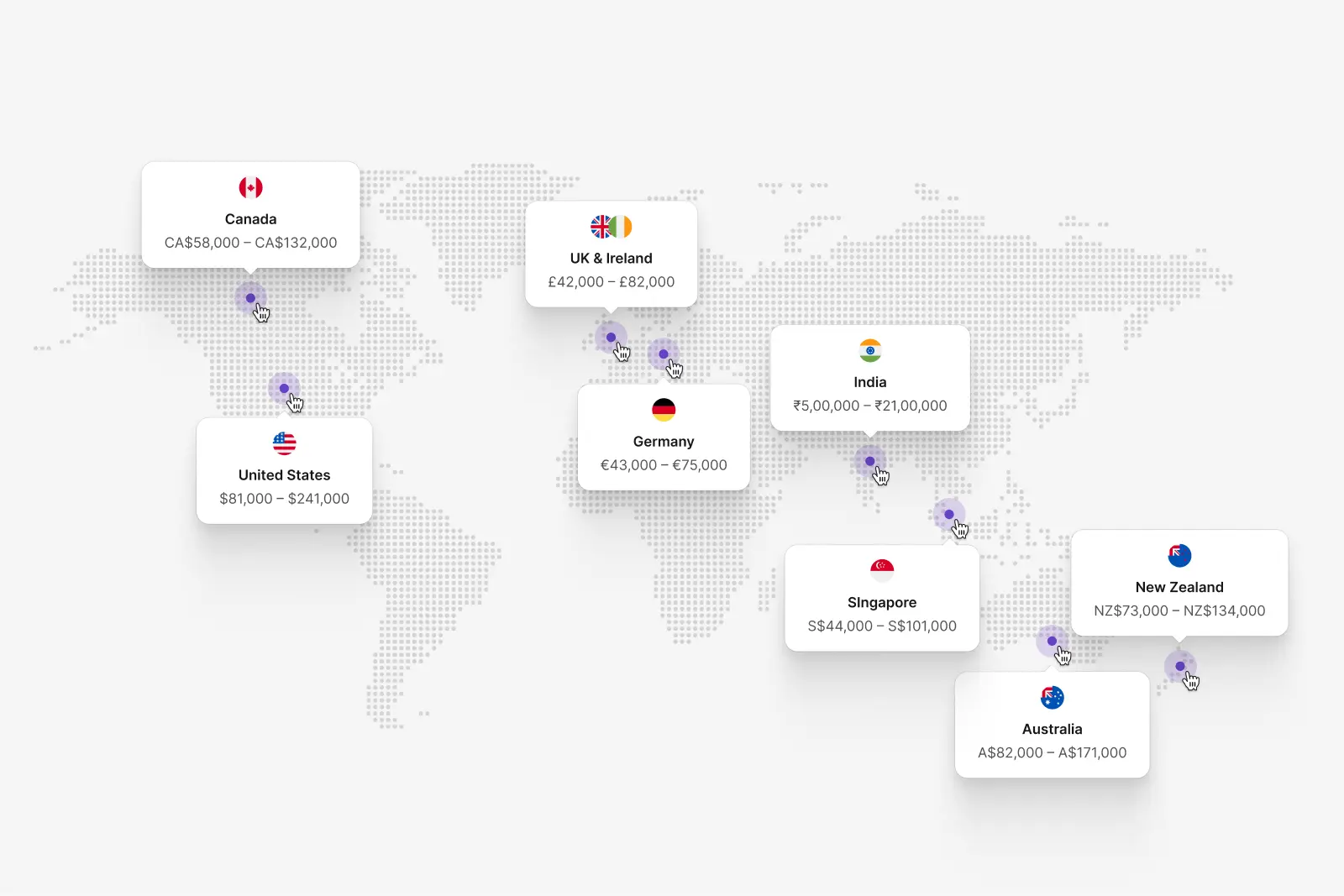
- Outside the US, UX salaries are lower: a median of about £48,000 in the UK, CA$78,000 in Canada, A$105,000 in Australia and €54,000 in Germany.
- Job security is better than the headlines suggest: the BLS projects 5% growth for web and digital interface designers through 2035, with about 13,600 openings a year, but junior designers face the most competitive part of the UX design field.
- Related titles pay differently: UX strategists ($146,000) and UX researchers ($122,000) earn more than the average UX designer salary, UI UX designers ($105,000) about the same, and UX writers ($89,000) less.

UX designer salary at a glance (2026)
Here is the average UX designer salary (or median salary, where the source publishes one) that each major source reports for the United States as of September 2026. The "what it measures" column is the important one; it explains most of the spread in the salary range.
Take the middle of that table and you get a realistic 2026 picture: the average UX designer salary for a full-time role in the United States sits somewhere between $105,000 and $120,000, senior UX designers earn $150,000 to $200,000 in total pay, and the highest salaries go to designers at large tech companies once stock is included.
Why every site shows a different salary for UX designers
Three things explain the gap between Payscale's $84,141 average salary and Levels.fyi's $164,450 median salary:
- Base salary vs total compensation. Payscale, Indeed, Salary.com and Robert Half report base salary. Glassdoor reports total pay (base plus bonus and stock). Levels.fyi reports total compensation from verified offer letters. For a senior designer at a public tech company, stock can be a third of the package, so the same job looks very different depending on which number you read.
- Who submits the data. Levels.fyi skews heavily to tech companies and people who negotiated well. Payscale skews to a broader mix of industries, agencies and smaller companies. The BLS surveys employers across the whole economy.
- Postings vs people. Indeed and ZipRecruiter average the salaries in job ads, which reflect what companies are offering today for open roles, usually mid to senior. Self-reported sites average what people already in the job earn, including those hired years ago at lower rates.
Our rule of thumb: use Glassdoor or Robert Half to benchmark a UX designer salary offer from a typical company, use Levels.fyi to benchmark an offer from a tech company that pays equity, and use the BLS figure when you want the most conservative, economy-wide UX designer salary.

UX designer salary by experience level
Experience level moves a UX designer salary more than anything else. The step from junior designers to senior designers roughly doubles total pay in the United States, and the step to staff or principal adds another $40,000 to $75,000 on top. Here is the UX designer salary range at each level.
Glassdoor doesn't publish a reliable mid-level UX designer figure (its mid-level page has no submissions), so we've used the all-levels median as the anchor; in practice the salary range at that level runs from about $95,000 to $140,000.
Base-salary sources tell the same story at a lower level: Payscale reports $71,708 for UX designers with under a year of experience, $82,574 for one to four years, and roughly 34% more than average for designers with 10 to 19 years.
Salary.com puts junior UX designers at $81,350 and senior UX designers at $116,146 in base salary.
Two things to know about the entry level in 2026. First, the junior end of the market is the most crowded.
Nielsen Norman Group's State of UX 2026 notes that senior designers and generalists are recovering faster than junior designers, and that the supply of junior designers still exceeds demand.
Second, the gap between a strong junior and a weak one is huge, and the junior UX designer salary range ($69,000–$128,000) reflects that.
A junior with a real portfolio, solid UI design skills and fluency in Figma can land at the top of the $69,000–$128,000 range; a bootcamp graduate with a template portfolio often can't get in the door.

UX designer salary by location: the highest-paying cities in the US
Location is the second biggest factor. The highest-paying cities for UX design jobs are San Francisco and New York City, where postings advertise a UX designer salary 25% to 30% above the United States average, and total compensation in the Bay Area is higher again once tech equity is counted. Seattle, Boston and Los Angeles round out the list.
Sources: Indeed (updated 31 August 2026) and Built In (2026). Indeed's figures come from job postings, so they reflect current offers; Built In's come from self-reported salaries.
The Los Angeles gap is worth noting: Los Angeles has a large design market but a lower average UX designer salary than New York City or Seattle, most likely because entertainment and agency roles dilute the tech average.
For product design roles, Levels.fyi's metro medians follow the same order:
- San Francisco Bay Area: $230,000
- Seattle: $200,000
- Boston: $175,000
- New York City: $160,000
- Austin: $150,000
- Los Angeles: $145,000.
UX designer salary by state, and the California UX designer salary
By state, ZipRecruiter ranks Washington ($120,309), the District of Columbia ($120,035), New York ($116,212) and Massachusetts ($116,009) as the states with the highest salaries, with Florida ($79,380), West Virginia ($82,235) and Arkansas ($87,837) at the bottom.
The California UX designer salary is a common search and a misleading number: ZipRecruiter's state average is $104,833, below the United States average, because it blends the Bay Area and Los Angeles with the rest of the state.
The real California UX designer salary picture is two markets: $134,865 to $154,168 in San Francisco and about $94,142 in Los Angeles. Treat state-level numbers as a rough guide and benchmark against the city you'd actually work in.
The location premium has narrowed since 2022 because so many companies now pay on national or tiered bands rather than local rates. It has not disappeared. If you're negotiating a remote role with a company headquartered in San Francisco, New York City or Seattle, ask which pay band your location falls into before you anchor on their headline salary range.
UX salaries around the world
United States UX salaries are the outlier.
In most other markets, the average UX designer salary is 40% to 60% lower in nominal terms, although the gap shrinks once you adjust for cost of living, healthcare and the fact that stock is rarely part of the package.
All UX salaries below are in local currency, from Glassdoor's country sites unless stated, and were checked in September 2026.
🇬🇧 United Kingdom and 🇮🇪 Ireland
UK UX salaries for contractors are a different world. IT Jobs Watch puts the median UX designer day rate at £463 (£520 in London), and YunoJuno's 2026 rates report has UX at £452 a day.
At 200 billable days that is £90,000+, which is why so many experienced UK designers contract. Big tech in the UK sits far above the local median: Levels.fyi reports product designer medians of £153,884 at Meta and £144,922 at Google in the UK.
🇨🇦 Canada
Canadian UX salaries cluster in Toronto and Vancouver, and the top of the market is set by US companies hiring locally. Levels.fyi's Canadian product designer leaderboard is led by Google (CA$193,314 median total comp) and Shopify (CA$191,829).
🇦🇺 Australia and 🇳🇿 New Zealand
We're based in Melbourne, so we watch Australian UX salaries closely. The A$105,000 Glassdoor median salary is a fair benchmark for a mid-level UX designer at a typical Australian company. The ceiling is set by Atlassian, Canva and the big banks: Levels.fyi puts product designer medians at A$188,618 at Atlassian, A$166,595 at Canva and A$160,853 at NAB.
🇩🇪 Germany, 🇫🇷 France and the 🇳🇱 Netherlands
🇮🇳 India and 🇸🇬 Singapore
India is the market with the widest spread in UX salaries. Glassdoor's ₹9,00,000 median covers the whole country, but designers at Google, Microsoft and Salesforce in India report Levels.fyi medians between ₹66,00,000 and ₹78,00,000, which is 7 to 9 times the national figure.
The same pattern applies in Singapore, where Grab (S$179,161) and ByteDance (S$152,264) pay well above the S$117,135 Levels.fyi median.
How much do UX designers make at big tech companies?
At most large tech companies, UX designers and UI UX designers all sit in the "product designer" job family, so this is the data to use when benchmarking a UX designer salary offer from Google, Meta, Apple or similar.
These are the highest salaries in the UX design field. The figures below are median total compensation (base, annualized stock and bonus) for US roles, from verified submissions to Levels.fyi, as of 6 September 2026.
Levels don't map neatly between companies, but as a guide Levels.fyi lists Google L5 as the senior designer level (typically 10 to 11 years' experience), and Meta IC5, Apple ICT4 and Amazon L6 sit at a similar point. A few things stand out.
Entry level at these companies ($130,000 to $190,000) already matches or beats the senior UX designer median at a typical company. Senior designers ($250,000 to $350,000) are where stock starts to dominate the package.
And the top of the ladder takes a long time to reach: Google L7 product designers typically have 17 to 18 years of experience.
Glassdoor's company medians run lower because they mix in submissions that don't include stock: Meta $277,000, Apple $257,000, Microsoft $199,000, Google $195,000, Amazon $177,000. If you're comparing an offer, use the Levels.fyi figure for the specific level you've been offered, not the company-wide median.
Pay growth at this end of the market has slowed. Levels.fyi's 2025 End of Year Pay Report shows product designer median pay up just 1.84% year on year, well behind the increases for AI and research roles.

How do remote, freelance and contract UX designer salaries compare?
Remote UX designers earn about the same as in-office designers at the same company, because most employers now pay on the same bands regardless of where you sit (sometimes adjusted by location tier).
Where remote pay looks higher in the data, it's a selection effect: the companies hiring fully remote designers are disproportionately funded software companies. Built In, for example, reports an average base of $152,588 for remote product designers against $115,705 for all US product designers.
Remote roles are also a shrinking share of the market: AcademyUX's June 2026 job market update puts remote at 30.7% of US UX postings, down from 32.6%.
Freelance and contract UX designers bill by the hour or day, and the rate depends heavily on where the client is and how senior you are:
- Contract Rates (US, 475 submissions, March 2026): $82 an hour average, with the middle half between $50 and $111 and the top 10% above $150. Rates were down 12.1% year on year.
- Contra's rate guide: $30–$60 an hour for junior freelancers, $60–$120 for mid-level, $120–$250 for senior, $250+ for specialists.
- Glassdoor estimates freelance UX designers at $42–$76 an hour, or about $117,000 a year in total pay.
- UK day rates: £463 median (IT Jobs Watch), £452 (YunoJuno), with Malt reporting €337 a day for freelancers with 0–2 years' experience rising to €507 for 15+ years.
- Upwork's median for UX designers is $27 an hour, which reflects a global marketplace, not what experienced designers in the US, UK or Australia charge.
A full-time freelancer billing $82 an hour for 1,200 hours a year grosses about $98,000, before tax, insurance, unpaid admin and gaps between contracts. That's why freelancing only clearly beats employment once you're charging senior rates ($120+ an hour) or working day rates in the UK contract market.

UX designer vs product designer vs UI designer salary
The three titles overlap heavily, and at many companies they describe the same job. The product designer salary is the highest in 2026, the UI designer and UX designer salary are close, and the gap between UX and product design widens with seniority.
Fast Company's analysis of job listings found the two roles start at roughly the same $70,000, but by four to five years' experience product designers were offered $149,850 against $123,720 for UX designers, and by eight or more years the gap was about 28% ($197,579 vs $153,920).
The usual explanation is that product designers are expected to own outcomes and business metrics, not just the research and interaction layer, and companies pay for that ownership.
The practical takeaway: if your work already spans user research, interaction and visual design and you're involved in what gets built, you're doing product design, and you should be applying for product designer roles and benchmarking against product designer salaries. We cover that market in detail in our product designer and UI designer salary guide.

UI UX designer, UX researcher, UX writer and UX strategist salaries
Job titles in the UX design field are messy, and a UI UX designer salary search returns a different number from a UX designer salary search for a job that is usually identical.
The same person can be advertised as a UX designer, a user experience designer, a UI UX designer or (in agency listings) one of the "UX UI designers" depending on the company, and the specialist titles (UX researcher, UX writer, UX strategist) pay on their own scales.
Here is how each compares with the average UX designer salary in the United States, using Glassdoor median total pay unless stated.
Three things stand out. First, the UI UX designer title costs you money on average.
Salary.com puts UX/UI designers at $92,047 against $114,033 for UX designers, and Glassdoor's UI UX designer median is $3,000 below the UX designer median, because it is the title small companies use when they want one person to do two jobs.
If you're applying for UI UX designer roles, benchmark against the UX designer salary, not the UI UX average, and expect an offer to land somewhere between $3,000 (the Glassdoor gap) and $22,000 (the Salary.com gap) below the equivalent UX designer offer.
Second, if you are one of the many UX UI designers doing research as well as interface work, know that user research is the best-paid specialization inside the UX design field: UX researchers earn about $14,000 more than UX designers at the median, and a designer who runs their own research can ask for the top of the salary range.
Third, UX writers and graphic design roles sit well below UX designers, which matters if you're moving into UX from either: the move is typically worth $19,000 to $45,000 at the median.

What actually moves a UX designer salary
Beyond experience level and location, six things consistently separate the UX designers earning $90,000 from those earning $200,000 with the same years of experience:
- Company type and company size. Public tech companies and well-funded startups pay in stock as well as cash. Agencies, non-profits, government and most non-tech companies pay base salary and a small bonus. Company size cuts both ways: the highest salaries are at large public tech companies, but well-funded startups with fewer than 200 people often match them in total compensation because equity makes up the difference, while small agencies pay the least regardless of company size. The same senior title can be worth $120,000 at an agency and $300,000 at Meta.
- Industry. Industry matters almost as much as company type. Within non-tech employers, the finance and insurance industry pays the most: the BLS reports a $133,260 median salary for digital interface designers in finance and insurance, $130,140 in the information industry, and $109,990 in computer systems design. Healthcare, government and retail are the industries where the average UX designer salary sits below the national figure, so changing industry is often the quickest raise available.
- Scope of the role. Designers who own a product area end to end, run their own user research and ship measurable results are paid like product designers. Designers who hand off wireframes are paid like UX designers.
- AI fluency. Designer Fund's AI in Design 2026 survey of 900+ designers found weekly AI use jumped from 54% to 91% in a year, half of design leaders now weight AI fluency in hiring decisions, and 65% of designers are taking on more product and engineering work. Only 4% of leaders have changed their compensation structure for it yet, so the premium currently shows up in who gets hired and promoted, not in a separate line on the offer.
- Portfolio quality. This is the single biggest lever at junior and mid level. Case studies that show the problem, the decisions, the shipped result and the outcome beat polished mockups every time. Building on a solid design system and a professional Figma UI kit lets you spend portfolio time on the thinking rather than redrawing buttons.
- Negotiation. Most companies have a band with 20% to 30% of headroom, and the first number is rarely the top of it. Designers who come in with a competing offer or a Levels.fyi benchmark for the exact level routinely add $10,000 to $30,000.

Is UX design still a good career in 2026? Demand, job security and the outlook
Yes, with a caveat about the entry level.
Job security for experienced designers is solid, and the underlying demand data backs that up: the BLS projects employment of web developers and digital interface designers to grow 5% from 2025 to 2035, faster than the average for all occupations, with about 13,600 openings a year.
Figma's 2026 survey of design leaders, cited by the UX Design Institute, found 82% said their need for designers had increased or stayed the same, and Designer Fund reports 60% of design leaders are holding or growing headcount.
The caveat is that the market is cooler than it was in 2021 and 2022, and cooler than it was even six months ago.
AcademyUX counted 52,670 US UX job postings in June 2026 and rated the market 40 out of 100 ("cool"), down from 68 in May, with product design postings down 9.9% month on month. Tech layoffs ran to about 124,000 people in 2025, according to layoffs.fyi.
The effect is uneven: senior designers who can show outcomes are still being hired quickly and have real job security, while junior designers face far more competition for fewer UX design jobs.
If you're starting out in the UX design field, the practical advice is to specialize early (user research, design systems, accessibility, AI product design), build a portfolio of real shipped work rather than concept projects, and get comfortable with the product side of the job.
Our list of UX design books and roundup of Figma courses are good places to start.

How to increase your UX designer salary
Most of the levers above are slow. These are the moves that change the salary you can command within a year or two:
- Move to a product designer title. Same skills, higher band, and a wider set of companies hiring. Product designer roles advertise about $30,000 more than UX designer roles on Indeed, and the gap to UI UX designer roles is larger again.
- Change companies every 2 to 4 years early in your career. Internal raises average 3% to 4% a year (Aquent's 2026 salary guide puts the average at 3.8%). External moves at mid level regularly add 15% to 25%.
- Target companies that pay equity. The difference between a $130,000 cash job and a $200,000 total comp job at the same level is almost entirely stock.
- Benchmark before you negotiate. Use Levels.fyi for the exact company and level, Glassdoor for the UX designer salary in your city, and Robert Half's percentiles for a sanity check. Then ask for the top of the salary range with a reason.
- Get measurably good at the tools. Speed in Figma, fluency with a design system and the ability to prototype with AI tools all show up in how much scope you get, and scope is what gets paid. If you want a fast way to level up your Figma work, start with our free Figma UI kit and the best Figma UI kits roundup.
- Consider contracting once you're senior. In the UK especially, £450–£520 a day for senior designers beats most permanent salaries, and the top US contract rates ($150+ an hour) are also reserved for them.
Where to find UX design jobs
These are the boards we'd check first for UX design jobs, in rough order of usefulness. Search for "UX designer", "user experience designer" and "UI UX designer"; the same roles are listed under all three titles.
- LinkedIn Jobs: the largest volume of UX designer and user experience designer roles, especially in New York City and Los Angeles, and where most recruiters post first.
- Wellfound: startup roles, usually with salary and equity ranges shown up front.
- Levels.fyi Jobs: tech company roles with the compensation data next to the listing.
- Dribbble Jobs: design-only board, strong for product, UI UX designer and visual roles.
- Layers: curated design jobs, mostly product design at software companies.
- Designer Fund job board: roles at design-led startups in the Designer Fund network.
- Glassdoor and Indeed: broad boards, useful because you can see salary data alongside the listing.
For remote UX design jobs specifically:
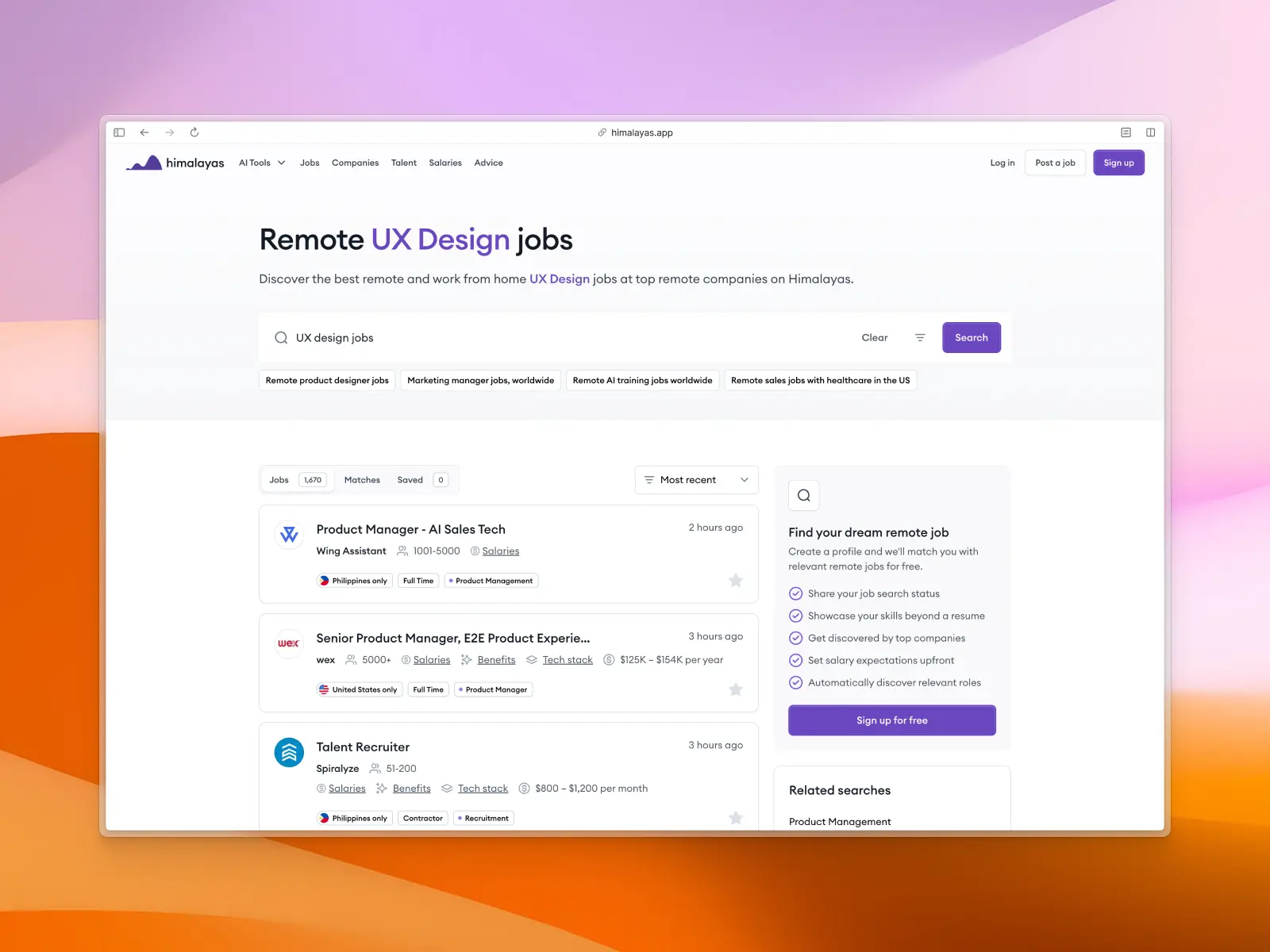
- Himalayas: remote-only, with company profiles that show time zones and location policies.
- We Work Remotely: long-running remote board with a dedicated UX/UI category.
- UX Gigs: UK-focused, with salary data from live listings.
How we compiled this data
Every figure in this guide was pulled directly from the source in the first week of September 2026:
- Glassdoor (US and country sites)
- Indeed
- Payscale
- ZipRecruiter
- Salary.com
- Built In
- Robert Half's 2026 Salary Guide
- Levels.fyi
- US Bureau of Labor Statistics (May 2025 wage data, published August 2026)
- IT Jobs Watch
- YunoJuno
- Contract Rates
- Designer Fund
- Nielsen Norman Group
- AcademyUX
Where a source reports a median salary we've used the median; where it only reports an average salary we've said so. Related-title figures (UI UX designer, UX researcher, UX writer, UX strategist, graphic designer) are Glassdoor medians pulled the same week.
We've deliberately included conflicting numbers rather than picking one, because the spread between sources is the most useful thing to understand when you're benchmarking your own salary. We'll update the guide as the 2026 data changes.
Conclusion
The honest answer to "how much do UX designers make" in 2026 is: an average UX designer salary of about $108,000 in total pay for a typical designer in the United States, $185,000 for senior UX designers, and $250,000 to $450,000 in total compensation for senior and staff designers at large tech companies.
Outside the US, expect UX salaries at roughly half those figures in the UK and Europe and 60% to 70% in Australia and Canada.
Experience level, company type, industry and the scope of the role move the UX designer salary far more than title or city, and the designers earning the highest salaries are the ones who own product outcomes, not just screens.
If you want to level up your own work, browse our Figma UI kit and React component library, or keep an eye on our blog for more on design careers and Figma.
More best practice guides
This post is an excerpt from Untitled UI Figma, world's largest Figma UI kit and design system. Untitled UI includes tips and best practices right in the Figma file to help you level up as a designer. You can preview Untitled UI Figma here.
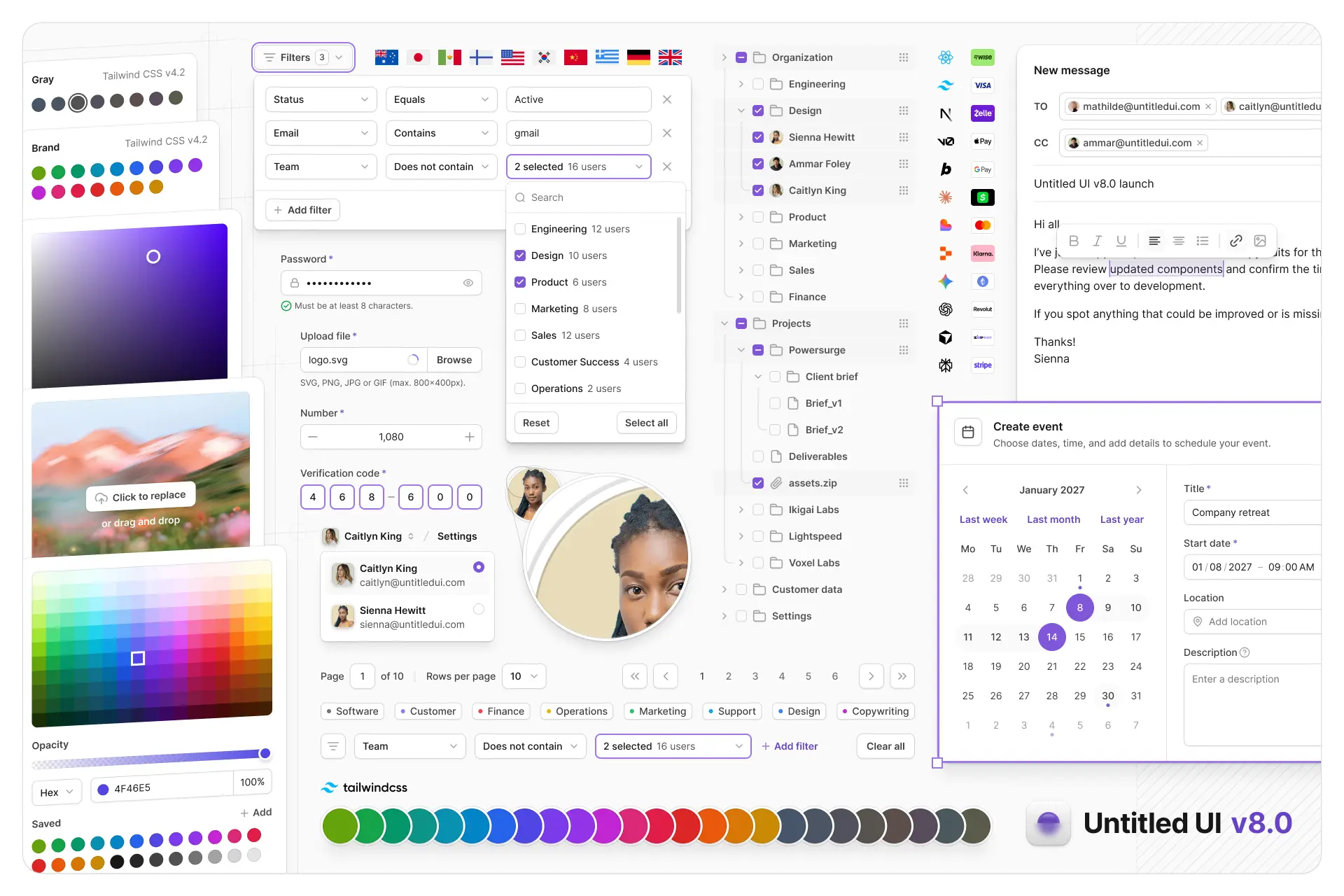
Untitled UI Figma is meticulously crafted with 100% Auto Layout 5.0, super-smart variants, Figma's newest variables features, and with accessibility in mind.
It's a great example of Figma design system best practices and is the most popular and highest-rated Figma UI kit on the internet with 3,650+ 5-star reviews!
We've also released Untitled UI Figma PRO LITE, which is a premium and lightweight version of the full Untitled UI Figma PRO STYLES kit and have included it for free. It's 55% lighter, faster, and is designed to include everything you need and nothing you don't. It's perfect for moving fast and for smaller projects!
Untitled UI was designed to be the "ultimate" UI kit and the perfect starting point for any kind of project—from beautiful marketing landing pages, all the way to complex dashboards and web apps—Untitled UI has thought of absolutely everything so you don't have to.
We're constantly making updates and improvements to the UI kit and recently announced that we've completely refactored Untitled UI to take advantage of Figma's latest features released at Config 2023, Framework 2024, Config 2024, Config 2025, and Config 2026. This includes all the latest Figma features such as color variables (dark mode), spacing, radius, typography, and effects variables, Auto Layout 5.0, min/max widths, Auto Layout wrapping, and much more.
You can check out a full preview of the design kit, or check out the 100% free UI kit here (which is more advanced than most UI kits in its own right!). If you're short on time, here's a 60-second overview: